How to Keep Your Savings in Crypto Safely
Crypto gives its owner more control over money. With control comes personal responsibility. A mistaken transfer cannot be reversed with a call to the bank, and a lost seed phrase often cannot be recovered.
Safe storage does not start with picking a nice app. First decide what share of your savings you are ready to hold in digital assets, what they are for and how quickly you may need access.
Everyday payments and long-term storage call for different tools. One wallet for everything is usually not enough.
Why people choose stablecoins
A stablecoin’s price is pegged to a regular currency. The best-known ones track the US dollar. That makes them less volatile than bitcoin and other crypto assets.
Stablecoins are used to:
- keep part of your funds in digital dollars;
- send money between countries;
- pay for deals quickly;
- not depend on bank opening hours;
- step out of volatile assets for a while;
- settle with contractors.
A stable price does not mean no risk. A stablecoin has an issuer, technical infrastructure and rules of circulation.
How USDT differs from USDC
USDT is issued by Tether. The coin is widely used on exchanges and is available on several networks. Because it is so widespread, it is often chosen for exchange and international settlements.
USDC is issued by Circle. This stablecoin also tracks the dollar and is used in payment and decentralised apps.
What matters is not only the name and the current price. Consider:
- the issuer’s stability;
- the composition and transparency of the reserves;
- the available blockchains;
- liquidity;
- support by your exchange or exchange service;
- the possibility of address freezes;
- legal restrictions.
A detailed comparison is in our article on the USDT, USDC and DAI stablecoins.
What issuer risk means
A stablecoin is not a cash dollar. You depend on the company that issues the token and manages the reserves.
The issuer can freeze assets at a specific address. There are also risks of rule changes, reserve problems, regulatory claims and a temporary loss of the dollar peg.
So do not treat any stablecoin as completely risk-free. For a large amount, it makes sense to spread it across different forms of storage.
Where to keep crypto
The main choice is between an exchange and your own wallet.
Keeping it on an exchange
An exchange is convenient for buying, selling and regular trading. You do not manage keys yourself, and access can be protected with a password and two-factor authentication.
But the platform actually controls the coins. It can limit withdrawals, request documents, stop operating or become the target of an attack.
It is reasonable to keep on an exchange the amount you need for upcoming operations. Long-term savings are better not left entirely on one platform.
To protect the account:
- use a unique password;
- turn on two-factor authentication via an app;
- save the backup codes;
- set up a whitelist of withdrawal addresses;
- check the website domain;
- do not follow links from random messages.
SMS codes are weaker than a separate authenticator app. A phone number can be reissued or intercepted.
Keeping it in your own wallet
Your own wallet gives you control over the private keys. But responsibility for keeping access safe lies with you.
If the seed phrase is lost, the app developer usually cannot restore the wallet. If a stranger gets the phrase, they can move the assets without your permission.
How to set up a USDT wallet and check it before the first transfer — in our step-by-step guide.
Hot and cold wallets
Hot wallet
A hot wallet is installed on a phone or computer and connects to the internet. It is convenient for transfers and small everyday amounts.
The main risks are malware, fake apps and phishing websites. Install a wallet only from the official source.
Do not keep a significant amount in a browser wallet that you regularly connect to unknown websites.
Cold wallet
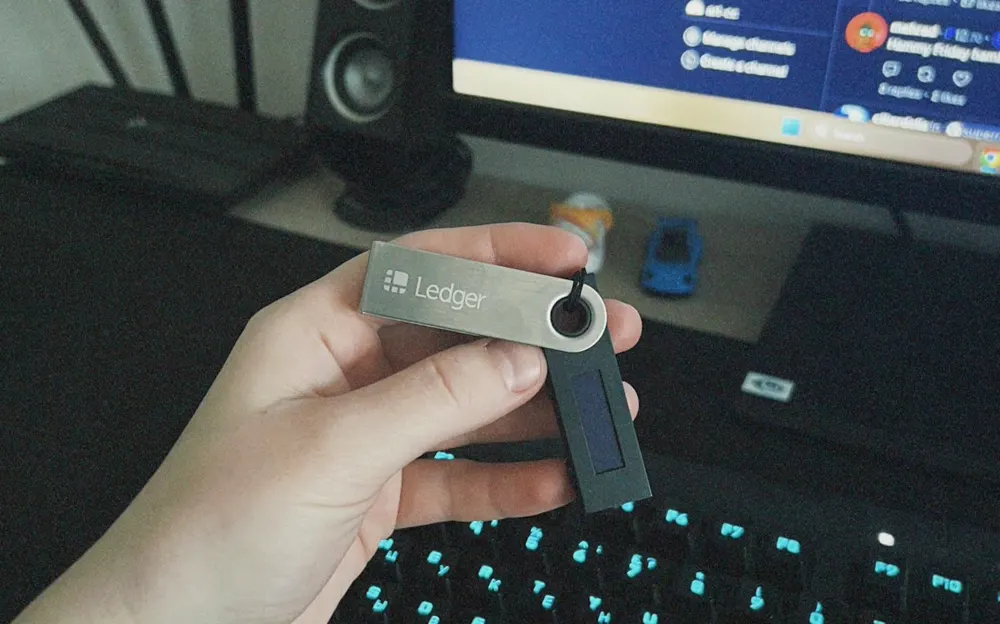
A cold wallet keeps the keys in an environment that does not expose them to the connected device. Most often this is a hardware wallet.
It suits long-term storage. A transaction is confirmed on a separate device where you can check the address and the amount.
Buy a hardware wallet from the company that makes it or from its official reseller. The device must not arrive with a ready-made seed phrase. The wallet creates the phrase itself during the initial setup.
What a seed phrase is
A seed phrase is a sequence of words from which the wallet keys are restored. Whoever knows these words controls the assets.
The main rule is simple. Never tell your seed phrase to anyone. Support staff, an exchange service and the wallet developer should never ask for it.
The main mistakes in keeping a seed phrase
It is dangerous to:
- take a screenshot;
- store a photo in the cloud;
- send the words to yourself in a messenger;
- keep the phrase in email;
- enter it on a website at the request of “support”;
- keep the only copy next to the device;
- label the envelope with the wallet name and the amount;
- pass the words to another person without a well-thought-out procedure.
It is better to write the phrase on paper or a metal plate and keep it in a protected place. For a large amount you can make several physical copies kept in different safe places.
Complex schemes for splitting the phrase suit only people who understand the recovery process. Split the words wrongly and you can lose access yourself.
How not to lose access
Creating a wallet is not enough. Test the recovery in advance.
A safe order looks like this:
- Create a new wallet on a trusted device.
- Write down the seed phrase without a digital copy.
- Check the order of the words.
- Get the wallet address.
- Send a small test amount.
- Make sure the balance shows up.
- Test the recovery on a compatible device.
- Only then send the main amount.
Also think through what happens if you lose your phone, the hardware wallet breaks or there is an emergency. Your family do not need to know the seed phrase right now, but they should have safe instructions in case they need them.
How to check an address before sending
A crypto address is a long string of characters. A mistake in even one character can send the funds to the wrong place.
Before a transfer, check:
- the selected coin;
- the sending network;
- the receiving network;
- the first and last characters of the address;
- whether an extra tag or memo is needed;
- that the recipient supports the network;
- the blockchain fee.
USDT exists on several networks. The same coin name does not mean the addresses are compatible. Agree on the network separately.
Malware can swap the address in the clipboard. So compare the characters after pasting, not only before copying.
Why a test transfer is needed
Send a small amount first. Wait for the confirmation and ask the recipient to check that it arrived.
After a successful test, check the address again. Some apps save the recipient, but do not rely on history alone.
An extra network fee usually costs less than losing the whole amount.
The risk of coins with a problematic origin
The history of operations on a public blockchain is preserved. Analytics systems assess links between addresses and thefts, fraud, hacks and other risky sources.
If coins carry a high risk score, an exchange or exchange service may stop the operation and ask for documents. The owner may have received the assets in an ordinary deal and not know their previous history.
Before a large crypto purchase, it is important to check:
- who you are buying the assets from;
- whether you can confirm the payment;
- whether there are documents for the deal;
- whether the address has been checked;
- whether dubious services for hiding the history were used.
An origin check does not give absolute protection, but it helps spot obvious risks before you receive the funds. How such a check works — in our article on AML checks.
How much to keep in crypto and in cash
There is no universal percentage. The decision depends on your income, expenses, country of residence and attitude to risk.
It helps to split money by purpose:
- a buffer for current expenses;
- a reserve for emergencies;
- money in the bank;
- cash;
- stablecoins;
- long-term investment assets.
Do not put into crypto money you will soon need for rent, medical treatment or a mandatory payment. It is also risky to keep all your capital in one stablecoin, on one network, in one wallet or on one exchange.
Cash gives independence from technology but can be lost or stolen. Crypto is convenient to move but requires protecting the keys. Spreading your money reduces dependence on any single scenario.
In short
Safe crypto savings rest on a few habits. Spread your assets, protect the seed phrase, check the network and the address, make a test transfer and keep documents showing where the coins came from.
At Ruber you can buy USDT, USDC, BTC or ETH for rubles by card or via SBP in the calculator. The coins go straight to your wallet — no need to keep them on an exchange. The rate and the final amount are shown before payment, and the exchange works around the clock and automatically. No wallet yet? Set one up with our step-by-step guide.
If you need cash, message the operator on Telegram: they will say whether it is possible in your case.